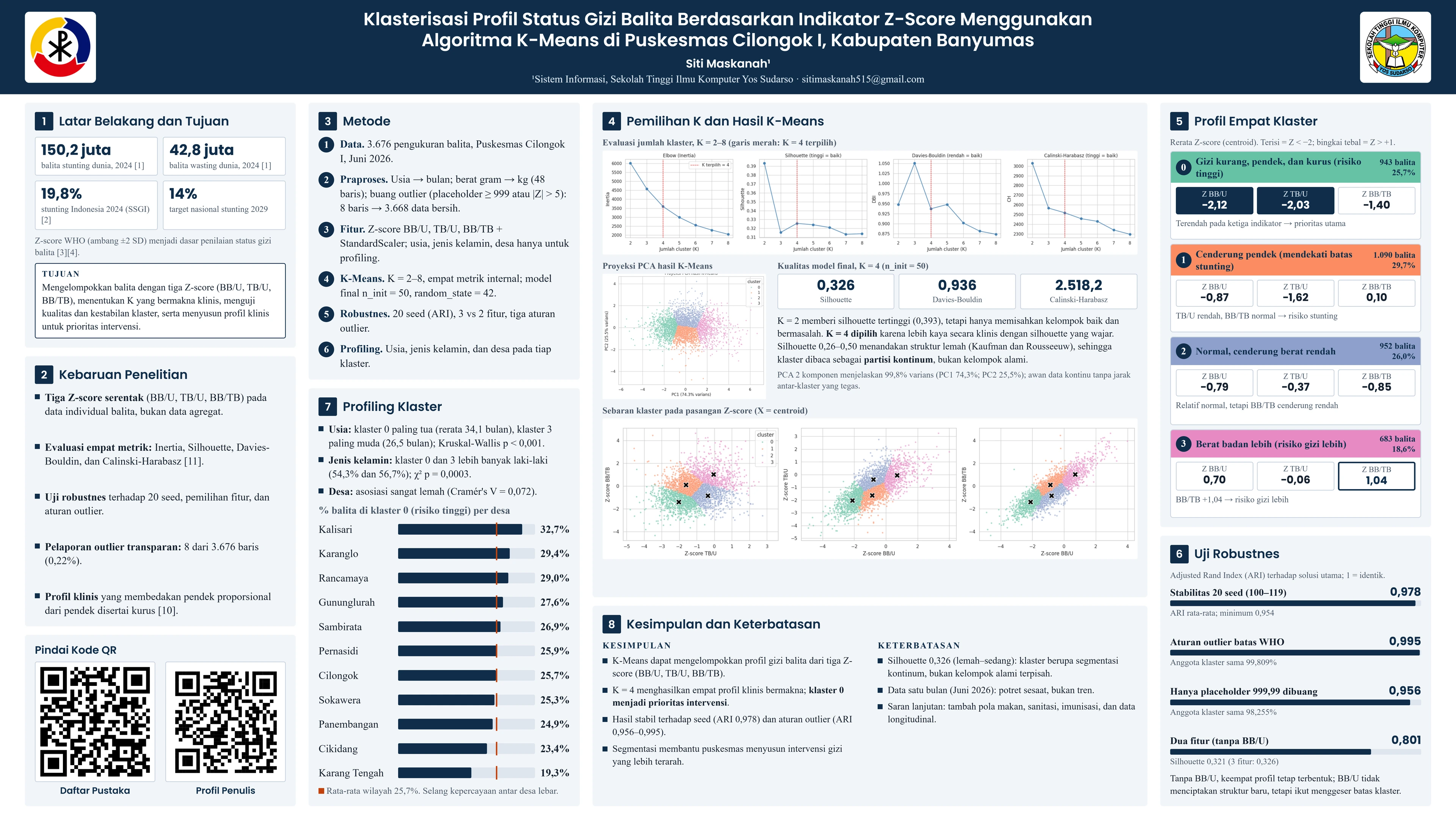
Child malnutrition remains a major public health concern. Globally, an estimated 150.2 million children under five were stunted, 42.8 million were wasted, and 35.5 million were overweight in 2024. Indonesia’s stunting prevalence was 19.8% in 2024, with a national target of 14.2% by 2029. This study used the K-Means algorithm to identify nutritional status profiles among children under five at Cilongok I Community Health Center in Banyumas, Indonesia. The dataset comprised 3,676 anthropometric measurement records collected in June 2026. After data cleaning and removal of eight outliers, 3,668 records were retained. Weight-for-age (WAZ), height-for-age (HAZ), and weight-for-height (WHZ) Z-scores were standardized before clustering. Values of K from 2 to 8 were evaluated using inertia, the silhouette score, the Davies–Bouldin index, and the Calinski–Harabasz index. Four clusters were selected based on the combined evaluation metrics and clinical interpretability. The resulting clusters had a silhouette score of 0.326, a Davies–Bouldin index of 0.936, and a Calinski–Harabasz index of 2,518.2. Cluster 0 comprised 943 records (25.7%) with underweight, stunting, and wasting profiles; Cluster 1 included 1,090 records (29.7%) with low height-for-age values near the stunting threshold; Cluster 2 contained 952 records (26.0%) with generally normal nutritional profiles but a tendency toward low body weight; and Cluster 3 comprised 683 records (18.6%) with excess body weight and a risk of overnutrition. Robustness testing showed an adjusted Rand index (ARI) of 0.978 across 20 random seeds, 0.801 when WAZ was excluded, and 0.956–0.995 under alternative outlier-handling procedures. These findings suggest that K-Means may support exploratory segmentation of nutritional profiles. However, the clusters represent divisions along a continuous nutritional spectrum and should not be interpreted as distinct natural groups or clinical diagnoses.
Keywords
child nutrition, children under five, anthropometric Z-scores, nutritional status, K-Means clustering, public health