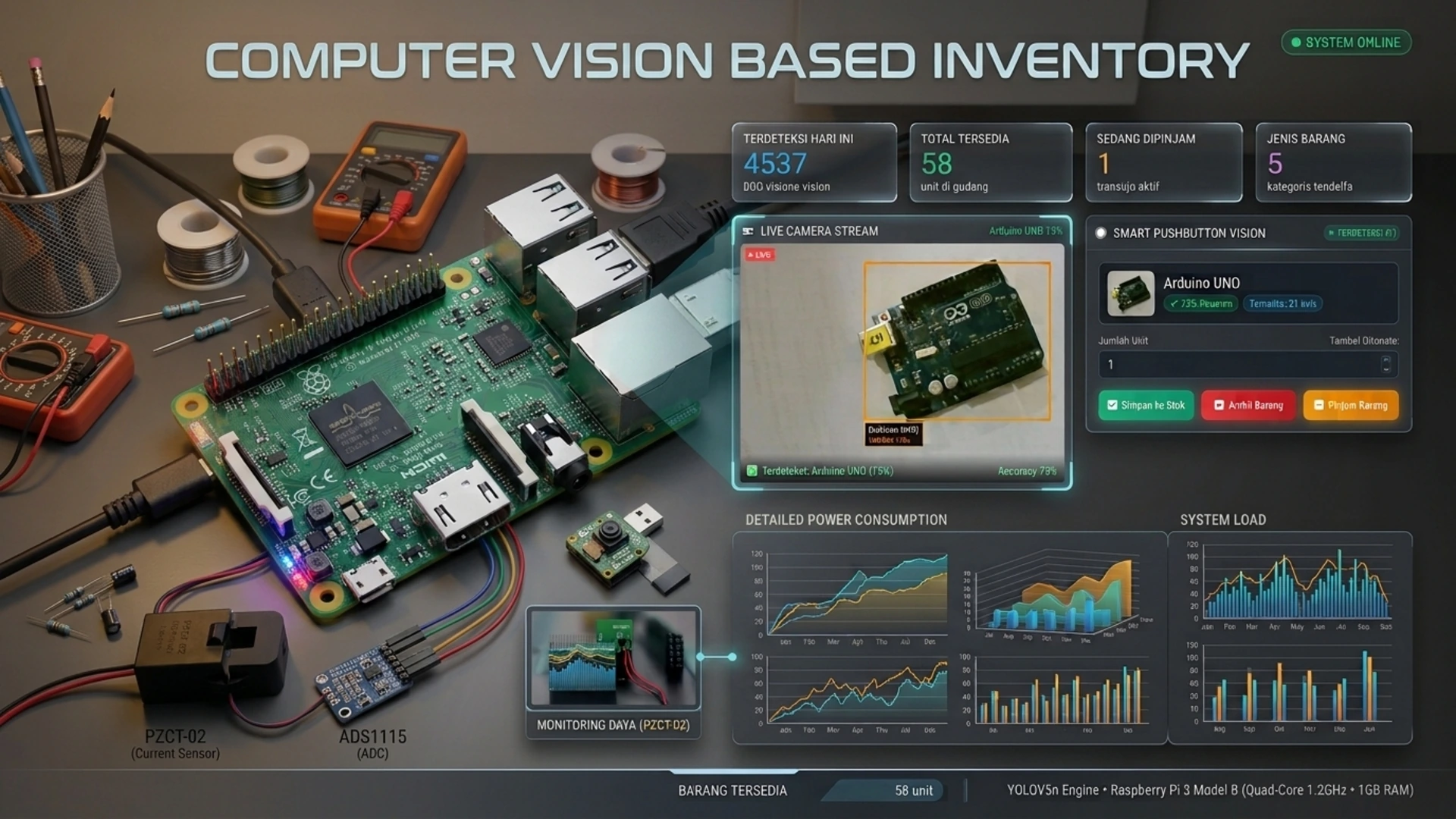
Component inventory management in engineering laboratories and workshops can be hindered by inefficient manual record-keeping, human error, and the risk of misplacing or misidentifying items. This study presents a smart inventory and electrical power monitoring system implemented on a Raspberry Pi 3B+ with 1 GB of RAM. The image-processing pipeline combines YOLOv5n object detection, executed through the OpenCV DNN C++ engine, with an ensemble TensorFlow Lite classifier and HSV-based color feature extraction to recognize components such as Arduino UNO boards, ESP32 WROOM-32 modules, 16 × 2 LCDs, breadboards, and smartphones. A local Flask-based dashboard supports item storage, retrieval, and borrowing records through a pushbutton-triggered vision mechanism with a 2.5-second hysteresis interval. Electrical monitoring uses a PZCT-02 current sensor and an ADS1115 16-bit I²C analog-to-digital converter to measure AC current, active power, and cumulative energy consumption. The system stores data locally in an SQLite database configured with Write-Ahead Logging (WAL). Initial performance testing showed an operating rate of 15–30 frames per second and RAM usage below 100 MB. These results indicate that the prototype can perform inventory recognition and power monitoring locally without relying on cloud services. Further testing is needed to evaluate recognition accuracy, inventory-record reliability, and measurement accuracy under varied operating conditions.
Keywords
edge computing, smart inventory, computer vision, YOLOv5n, TensorFlow Lite, Raspberry Pi, electrical power monitoring